DOE proposes BRICS environmental network to address ecological damage
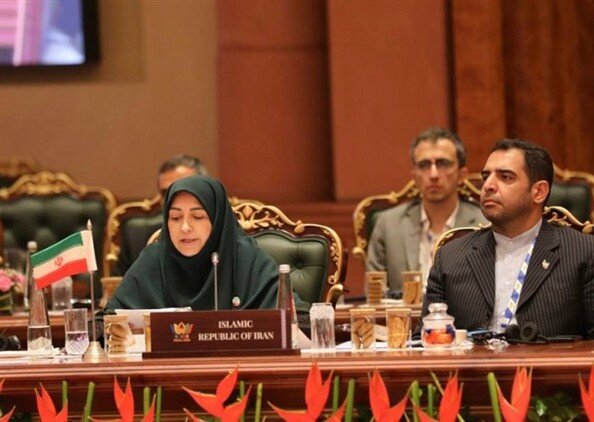
TEHRAN - Shina Ansari, the head of the Department of Environment, has called for closer environmental cooperation among BRICS member states, describing their combined capacities in natural resources, biodiversity, coastal and marine ecosystems, and other environmentally valuable areas as a “historic opportunity” to address the growing global environmental crisis.
Speaking at the 12th BRICS Environment Ministers’ Meeting in New Delhi on Tuesday, Ansari proposed placing environmental security alongside energy and food security, establishing a BRICS network to monitor and assess environmental damage resulting from armed conflicts and climate change, creating a rapid-response mechanism for marine pollution and hazardous-material spills, and expanding the exchange of technologies and expertise for restoring damaged ecosystems.
She also called for stronger cooperation between BRICS countries and specialized international organizations to address the environmental consequences of crises and to pursue accountability for those responsible for environmental destruction, based on the principle that “the polluter must pay.”
Ansari further proposed launching discussions on a common BRICS framework for environmental protection during armed conflicts.
Emphasizing the direct link between peace, security and environmental protection, she called for a joint mechanism among BRICS members to monitor and respond to environmental damage caused by armed conflicts and climate-related crises.
“Environmental protection is not merely a theoretical issue; it is directly linked to the peace and security of countries and peoples,” Ansari said.
On 28 February 2026, the Islamic Republic of Iran was subjected to widespread, unlawful and uncivilized military aggression by the United States and the Zionist regime. This aggression, in addition to the martyrdom of the Supreme Leader and innocent people, particularly the innocent children of the Minab school, as well as extensive damage to civilian and non-military infrastructure, has also caused significant environmental impacts and risks that concern the entire world.
“Energy facilities, industrial infrastructure and other vital installations in times of war are not merely buildings and equipment; they are part of an interconnected system whose destruction can result in the release of pollutants, chemicals, fuel and other hazardous substances into the air, soil and water, while also aggravating the effects of natural phenomena such as global warming and dust storms.”
From this perspective, the environment is a silent victim of war—a victim whose consequences do not stop at Iran’s borders, she stressed.
Persian Gulf vulnerable to consequences of wars
Highlighting the particular importance of the Persian Gulf and the Gulf of Oman, Ansari said the two bodies of water are among the world’s most sensitive and fragile marine ecosystems.
“This issue is of even greater significance with regard to the Persian Gulf and the Gulf of Oman.
The Persian Gulf is one of the most sensitive and fragile marine ecosystems in the world. Its semi-enclosed and shallow waters, valuable aquatic resources, coral habitats, mangrove forests, sandy coastlines, and habitats of marine and migratory species are all vulnerable to pollution and disruptions caused by military activities.
Moreover, these two marine areas have already suffered extensive environmental damage as a result of the consequences of previous wars and the presence of military fleets of extra-regional powers over the past three decades.”
“This reality conveys a clear message to the international community: War in one region does not necessarily remain confined to that region; its environmental consequences can persist across generations and throughout the planet.”
Accountability for environmental destruction
International law has long emphasized the fundamental principle that States must prevent the infliction of transboundary environmental harm.
The principle of prevention of transboundary harm, the duty to cooperate, environmental impact assessment, and the principle of reasonable and responsible use of shared natural resources now constitute important elements of international environmental law.
At the same time, international humanitarian law imposes limitations on the methods and means of warfare and provides protection to the natural environment against certain forms of severe, widespread and long-term damage.
These principles convey a common message: War cannot constitute a licence for the unrestrained destruction of nature.
More importantly, the environment must not be regarded in military calculations merely as “collateral damage.”
When an unlawful military aggression results in the pollution of shared waters, the destruction of marine habitats, the release of toxic substances, or the destruction of vital environmental infrastructure, its consequences can directly affect human health, food security, economies and the livelihoods of millions of people.She added that BRICS could become an effective platform for cooperation among countries of the Global South in protecting the environment, ensuring that no ecosystem in the 21st century becomes a “silent victim” of political and military conflicts or violations of international law.
Utilizing the potential of BRICS
BRICS today brings together major, diverse and influential countries of the Global South—countries that collectively encompass a significant share of the world’s natural resources, biodiversity, coastlines, oceans and valuable ecosystems, Ansari highlighted.
“Utilizing the potential of BRICS to establish a new approach to South-South cooperation is both a historic responsibility and a historic opportunity, and we must seize it.”
Ansari added that “Our priority areas could include the following:
- Placing “environmental security” alongside energy security, food security and the security of human societies as an undeniable necessity.
- Establishing a BRICS network for monitoring and assessing environmental damage resulting from armed conflicts, as well as natural developments associated with climate change, by making use of scientific capacities and advanced technologies.
- Establishing a cooperation mechanism for rapid response to marine pollution, hazardous-material spills, forest and natural-habitat fires, and dust storms, particularly in sensitive areas.
- Exchanging experiences and technologies among Member States in the restoration of ecosystems damaged as a result of war and armed conflict.
- Strengthening cooperation among Member States and with relevant specialized international institutions to jointly address the impacts and consequences of phenomena affecting the environment, to condemn aggression, and to hold the aggressor accountable on the basis of the principle that the polluter is responsible for providing compensation.”
“We should also initiate discussions on the development of a common BRICS framework for the protection of the environment in situations of armed conflict.
If, today, the international community and the institutions responsible for addressing these matters remain silent in the face of environmental destruction resulting from the unlawful aggression of a rogue State in the international system against the Islamic Republic of Iran, tomorrow the same standard may be applied elsewhere in the world against the environment and against another people.”
“Today, the world is facing three major environmental crises: climate change, biodiversity loss, and pollution.
However, alongside these three crises, war, unfortunately, is less frequently discussed as an aggravating factor.
War can intensify all three crises. It can increase the release of pollutants and greenhouse gases; it can destroy habitats and biodiversity; and it can contaminate water, soil and the marine environment.
The special protection of the environment against the consequences of war is an ethical, humanitarian and legal necessity.
And Iran’s message to this meeting is clear: Peace is a necessity for the environment, and the protection of the environment is itself part of the path towards lasting peace.
We must transform BRICS into a platform for cooperation among the countries of the Global South to protect the environment against the aforementioned threats and factors.
We must ensure that, in the twenty-first century, no ecosystem becomes a silent victim of political and military conflict, unlawful conduct, or the uncivilized actions of a powerful and coercive State.
Silence and inaction in the face of the current trends will make the crisis increasingly difficult and costly for the world with each passing day,” she concluded.
Leave a Comment